Redefining Inclusion in Humanitarian Response: Building Momentum for an Inclusive 2026 HNRP
Category
General Somalia & Somaliland
© Amal Abdilahi/ HI
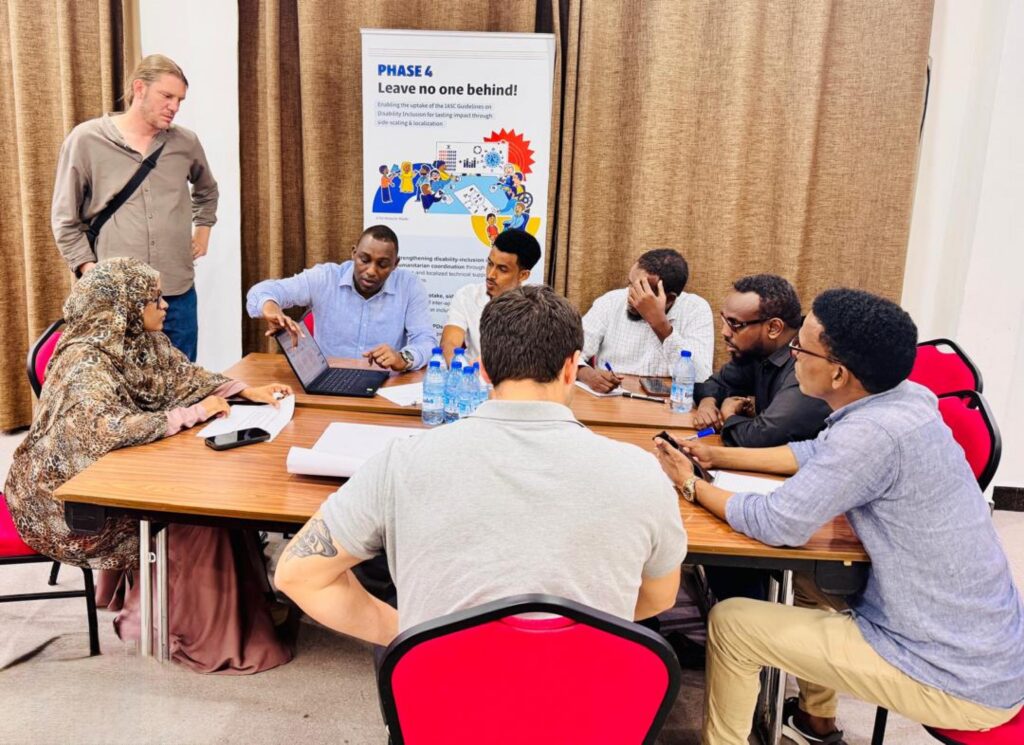
On 21 October 2025 in Mogadishu, Phase 4 – Leave no one behind! project team in Somalia and Somaliland, with technical support from the Global Inclusive Humanitarian Action (IHA) Specialist, conducted a one-day workshop on disability-inclusive Humanitarian Needs and Response Planning (HNRP) to strengthen the capacity of key humanitarian actors. The event brought together seventeen participants (four women and thirteen men) representing Organizations of Persons with Disabilities (OPDs), government institutions, IMPACT, the Inter-Cluster Coordination Group (ICCG), and cluster and working group coordination leads.
The workshop aimed to enhance participants’ understanding and skills for systematically integrating disability inclusion into humanitarian planning and coordination. By promoting inclusive approaches, the initiative sought to ensure that the needs and priorities of persons with disabilities are clearly reflected, prioritized, and effectively addressed throughout all stages of the HNRP process, thereby strengthening accountability and equitable access to humanitarian services.
Building on this objective, the workshop sought to raise awareness and strengthen the understanding of key stakeholders involved in preparing the 2026 HNRP, emphasizing the importance of systematically integrating disability inclusion across all stages of the process. It also highlighted how inclusive planning enhances accountability, equity, and access to dedicated funding for disability-inclusive programming, ensuring that persons with disabilities are effectively considered and reached through humanitarian interventions.
Discussions during the workshop focused on promoting an inclusive HNRP, including a review of key gaps identified in the 2025 HNRP and proposing concrete actions to be adopted in the 2026 plan, guided by UNICEF’s Disability Inclusion Tip Sheet. Participants also explored what inclusive data for the HNRP should be structured to ensure meaningful representation, equity, and accountability.
The event brought together a diverse group of stakeholders actively engaged in the ongoing HNRP process. This inclusive participation encouraged discussion, collaboration, and a shared commitment to advancing disability inclusion within humanitarian planning and response in Somalia.
Overall, the workshop served as a critical step in strengthening coordination and accountability for disability inclusion. It enhanced the capacity of both OPDs and humanitarian actors to engage meaningfully in the HNRP process and laid the groundwork for sustained collaboration between OPDs, cluster leads, and government counterparts to ensure that the needs and priorities of persons with disabilities are consistently addressed in humanitarian interventions.
Angie Martin, Senior Assessment Officer at IMPACT, shared her reflection:
“We are pleased to have participated in this workshop, which provided us with new insights into the structure of an inclusive HNRP. We believe this knowledge will enable us to ensure that the needs and priorities of persons with disabilities are effectively addressed in our contributions to the HNRP.”
Text by: Amal Abdilahi, Somalia & Somaliland