
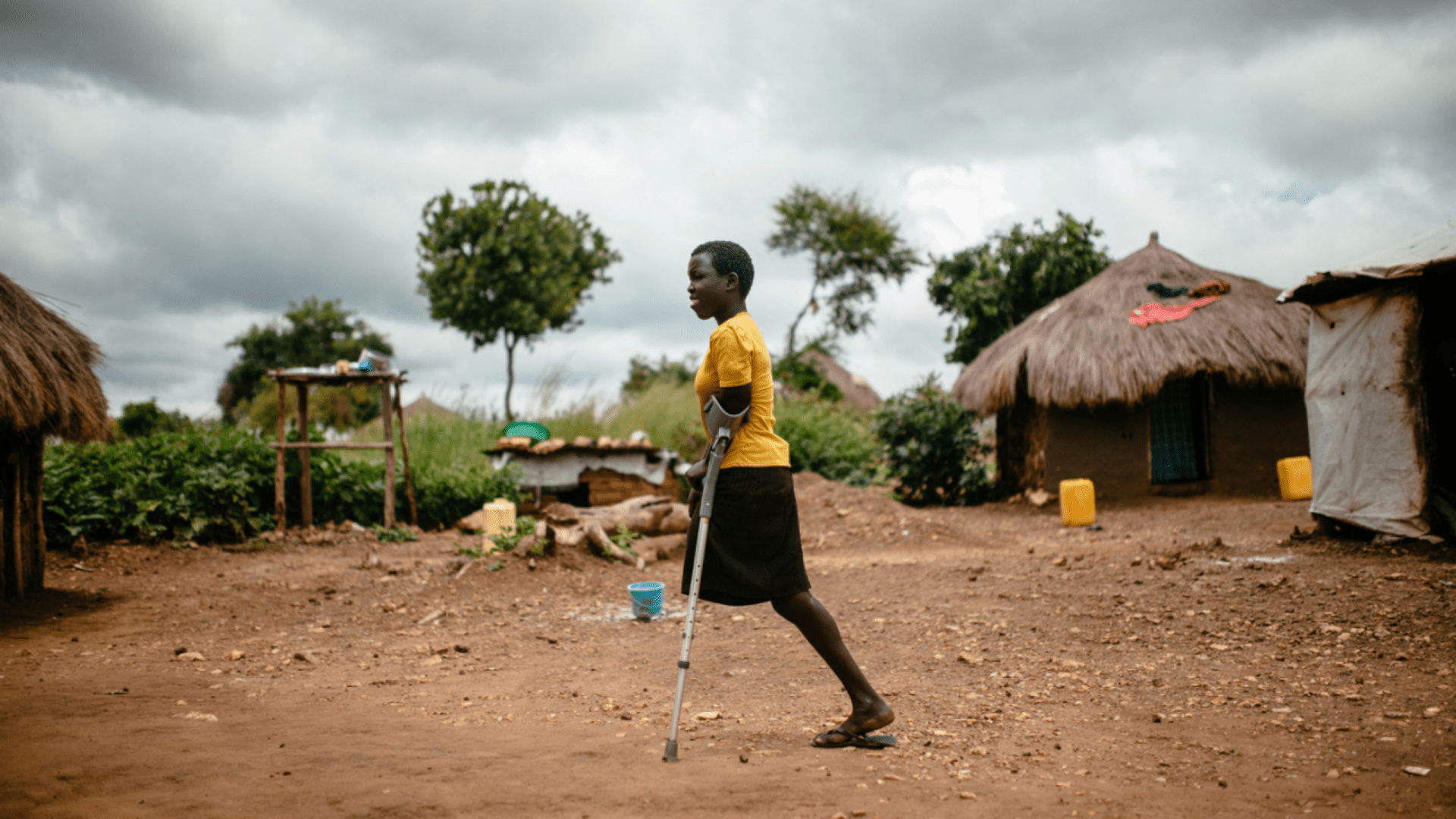
© Quinn Neely / HI
A new situational analysis by our OPD partner NUDIPU highlights the daily challenges faced by refugees with disabilities in Nakivale Refugee Settlement, Uganda. The findings call for stronger disability-inclusive humanitarian action.
As part of Phase 4 – Leave no one behind! (LNOB 4), the National Union of Disabled Persons of Uganda (NUDIPU)– a local Organization of Persons with Disabilities (OPD) and partner of the LNOB project- conducted a situational analysis in Nakivale. The study aimed to assess the living conditions of refugees with disabilities, focusing on barriers in access to services, participation, and protection.
LNOB supported NUDIPU in conducting the research by providing small grants.
Background
Nakivale is one of the largest refugee settlements in Uganda, hosting refugees from several neighboring countries. While humanitarian actors provide essential services, refugees with disabilities continue to face significant gaps in access and inclusion.
The study used a mixed-methods approach, combining quantities surveys, group discussions, and key informant interviews. Data given by 155 refugees with disabilities (including individuals with seeing, hearing, walking, cognitive, communication, and self-care difficulties, as well as those with multiple disabilities), was analyzed alongside input from humanitarian actors and OPD leaders.
Barriers in Daily Life and Access to Services
The analysis revealed multiple challenges for refugees with disabilities at Nakivale, including:
- physical inaccessibility of infrastructure (such as health care, food distribution points, education and livelihood opportunities),
- long distances to service points,
- limited assistive devices,
- and communication barriers.
Negative attitudes and limited awareness about disability further restrict participation. Some refugees with disabilities shared that they are often excluded from community meetings and decision-making processes:
“Sometimes meetings are called, but no one informs us. Even when we go, the place is not accessible.”
These findings show that disability inclusion is still not systematically integrated across sectors.
Protection Risks and Social Exclusion
The report also highlights heightened protection risks. Refugees with disabilities, particularly women, children, and older persons, face increased exposure to neglect, exploitation, and gender-based violence.
Limited access to information worsens the situation. When communication is not provided in accessible formats, some people with disabilities are left unaware of available services or complaint mechanisms.
The study emphasizes that exclusion is not only about infrastructure. It is also about attitudes, participation, and power dynamics within the settlement.
Strengthening Disability-Inclusive Humanitarian Action
The situational analysis provides practical recommendations. These include:
- improving physical accessibility of facilities,
- strengthening identification and referral pathways,
- providing assistive devices,
- ensuring accessible communication,
- building the capacity of humanitarian actors on disability inclusion,
- actively involving Organizations of Persons with Disabilities (OPDs) in planning and monitoring.
The findings reinforce the importance of working closely with refugee-led groups and OPDs to design solutions that respond to lived realities.
As one local stakeholder noted:
“Inclusion is not charity. It is about removing barriers so everyone can participate equally.”
Looking Ahead
The results of this assessment will guide future interventions in Nakivale. By grounding actions in evidence, the project aims to ensure that refugees with disabilities are not left behind in humanitarian response efforts.
Disability-inclusive humanitarian action requires commitment, coordination, and accountability. The voices captured in this analysis remind us that inclusion must move from policy to practice – only then can humanitarian action truly leave no one behind.
Text by: Ssennoga Martin Kigozi, Program Manager, NUDIPU