
Strengthening Disability Inclusion in Humanitarian Action: ToT Workshop Empowers Leaders in Yaoundé, Cameroon
Category
Cameroon Capacity Strengthening General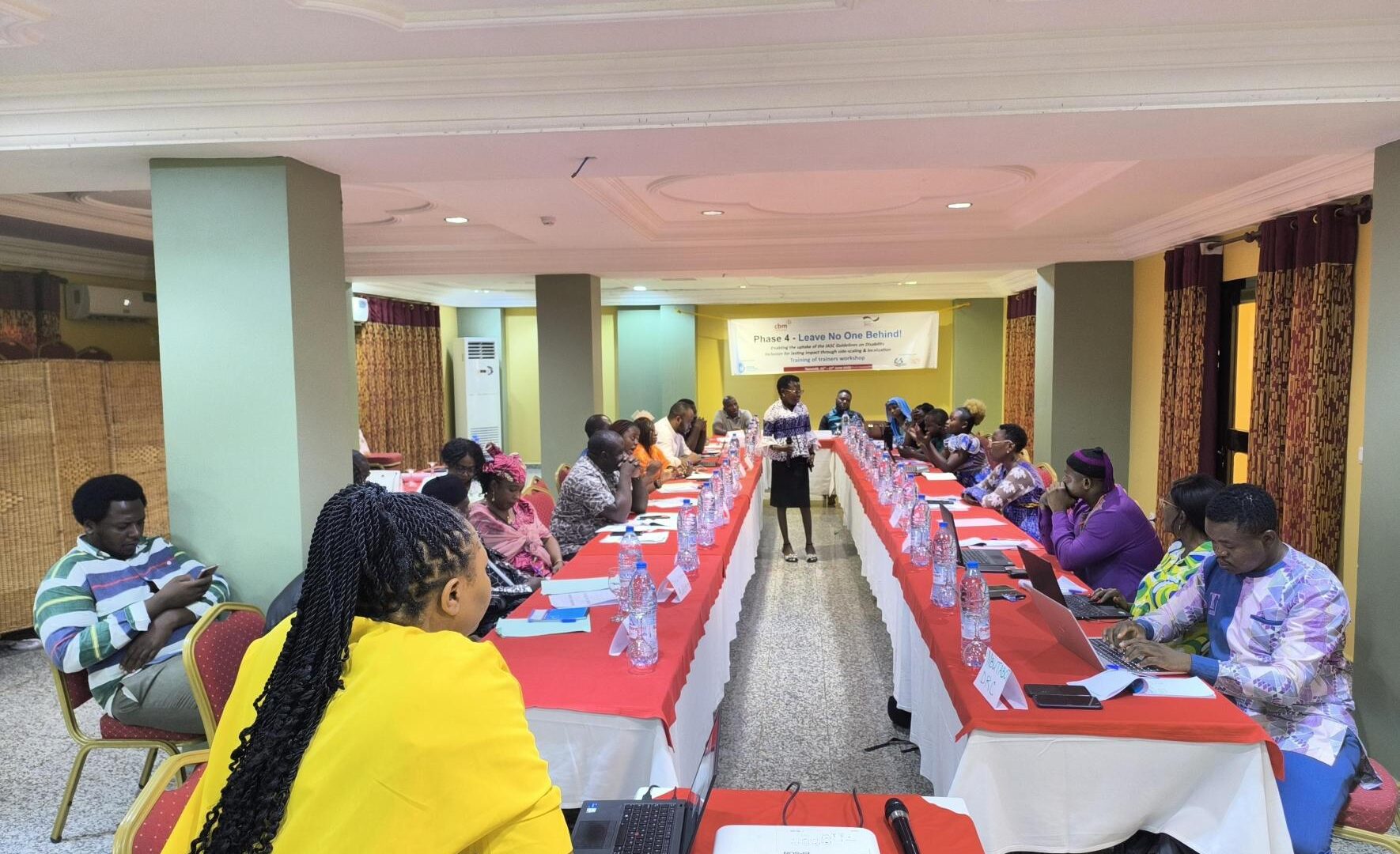
© CBM
Within the framework of the Phase 4 – Leave no one behind! – project, Christian Blind Mission (CBM), in collaboration with the Cameroon Union of Organizations of Persons with Disabilities (CUAPWD) and the Plateforme for Disability Inclusion, organized a Training of Trainers (ToT) workshop in Yaoundé, Cameroon. The event took place from June 25 to 27, 2025, at Hotel Jouvance International, bringing together a diverse group of stakeholders committed to advancing disability inclusion in humanitarian action.
The workshop aimed to strengthen the knowledge and technical capacity of members of the Disability Inclusion Pool of Experts, leaders of Organizations of Persons with Disabilities (OPDs), and disability inclusion focal points from selected humanitarian organizations. In total, 37 participants from 23 organizations attended, including 13 OPD leaders (5 women and 8 men; 3 visually impaired, 9 with mobility impairments, and 1 with a hearing impairment). Representatives from three United Nations agencies attended the workshop: the Office of the High Commissioner for Human Rights (OHCHR), the International Organization for Migration (IOM), and the World Food Programme (WFP). Five international non-governmental organizations (INGOs) were represented: Plan International, the Danish Refugee Council (DRC), the Norwegian Refugee Council (NRC), the International NGO Safety Organization (INSO), and Action Against Hunger (ACF). Two government ministries were represented: the Ministry of Social Affairs (MINAS) and the Ministry of Territorial Administration/Department of Civil Protection (MINAT/DPC).
The training was co-facilitated by Nogning Armelle from the CUAPWD and Yomby Luc from the Disability Inclusion Pool of Experts. They led sessions on the importance of collaborating with OPDs and persons with disabilities to mainstream disability inclusion in humanitarian response. The facilitators also shared valuable experiences from their work at the community level.
During the three-day session, participants deepened their understanding of disability concepts and the rights of persons with disabilities, as outlined in the United Nations Convention on the Rights of Persons with Disabilities (UNCRPD). Sessions emphasized the importance of engaging with OPD leaders and persons with disabilities and explored the Inter-Agency Standing Committee (IASC) Guidelines on including persons with disabilities in humanitarian action, including the four must-do actions. The workshop also covered using the Washington Group Short Set of Questions to collect and analyze disability-disaggregated data; rolling out Protection and Inclusive WASH training packages; and developing action plans to apply participants’ learning within their organizations.
At the conclusion of the workshop, participants expressed high satisfaction and called for further training opportunities to advance disability inclusion in Cameroon. Madame N’KESSA SINBERO, representing the MINAS, stated:
“I am joining my voice with the entire administration of the ministry of Social Affairs to appreciate CBM with regards to their work in improving the lives of persons with disabilities in Cameroon. Thanking CBM for the training, which was very enriching within the planned period, looking at the humanitarian crisis affecting the four regions, where persons with disabilities are being exposed to danger and not included in humanitarian assistance. With the understanding of the IASC guidelines, it will go a long way to better involve OPDs in decision making and improved data collection processes in Cameroon.”
Text by Barbara Achwe, CBM, Cameroon