
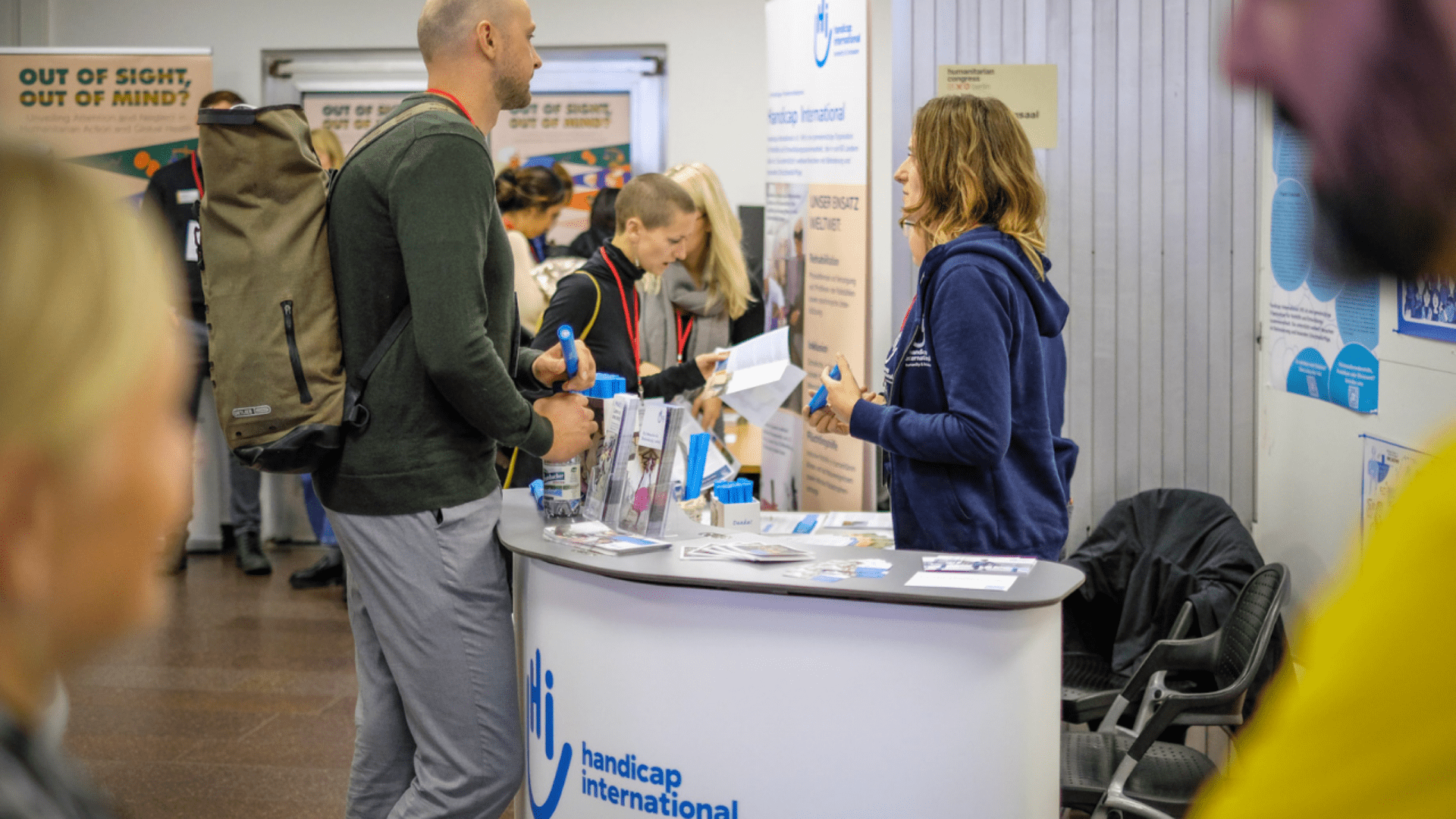
“Phase 4-Leave no one behind!” (LNOB), will be featured at the upcoming Humanitarian Congress Berlin 2026. This year’s congress, themed “Humanitarianism(s) in Transition: Between Ideals, Power and Agency,” will take place on April 21–22, 2026, at the silent green Kulturquartier in Berlin. We will be there for exchange and networking with fellow humanitarian actors and to present our project progress, which has moved on to the fourth and final phase.
The Humanitarian Congress Berlin provides an opportunity for experts, practitioners, and government and media representatives to join the conversation on humanitarian action and rethink and reshape its future. Humanitarian action is currently facing complex challenges, making it more important than ever to take disability-inclusion in humanitarian responses into focus and work to leave no one behind in crisis.
Visit Our Booth
Meet us at the Handicap International (HI)-booth in the Betonhalle to explore how the Leave no one behind! project is promoting disability-inclusive humanitarian action. Our team will be on hand to share insights, tools, and best practices developed through collaboration with humanitarian actors and organizations of persons with disabilities (OPDs) in East and West Africa.
At the booth, you’ll learn about our project accomplishments and publications, including:
- IASC-Guidelines of Inclusion in Humanitarian Action: The global guidelines on inclusion of persons with disabilities in humanitarian action, supported by Leave no one behind! during its development and dissemination and the foundation of our work.
- Training Materials: Such as the e-learning course on Introduction to Disability-Inclusive Humanitarian Action, inclusive WASH Training package to make water, sanitation, and hygiene services more accessible, and upcoming materials on Food Security
- Practical Tools: guidance for targeting, monitoring & assessing disability specific needs, risks and barriers in protection and food security and Toolkit on Disability Inclusion in Humanitarian Coordination.
- Reports and Case Studies: several useful studies or reports which give practical examples on how to advance Disability Inclusion in Humanitarian Action
- Learning Papers: recently published Disability Reference Group community of practice (CoP) learning papers, giving Insights and lessons on advancing disability inclusion in humanitarian coordination,
All materials are also available online on the project website. You can explore all our resources on Disability-Inclusive Humanitarian Action: Tools and Guidance.
Key team members will be available at the booth to discuss our work and answer your questions.
We look forward to seeing you in Berlin and exchange on the best practices on inclusive humanitarian action!