
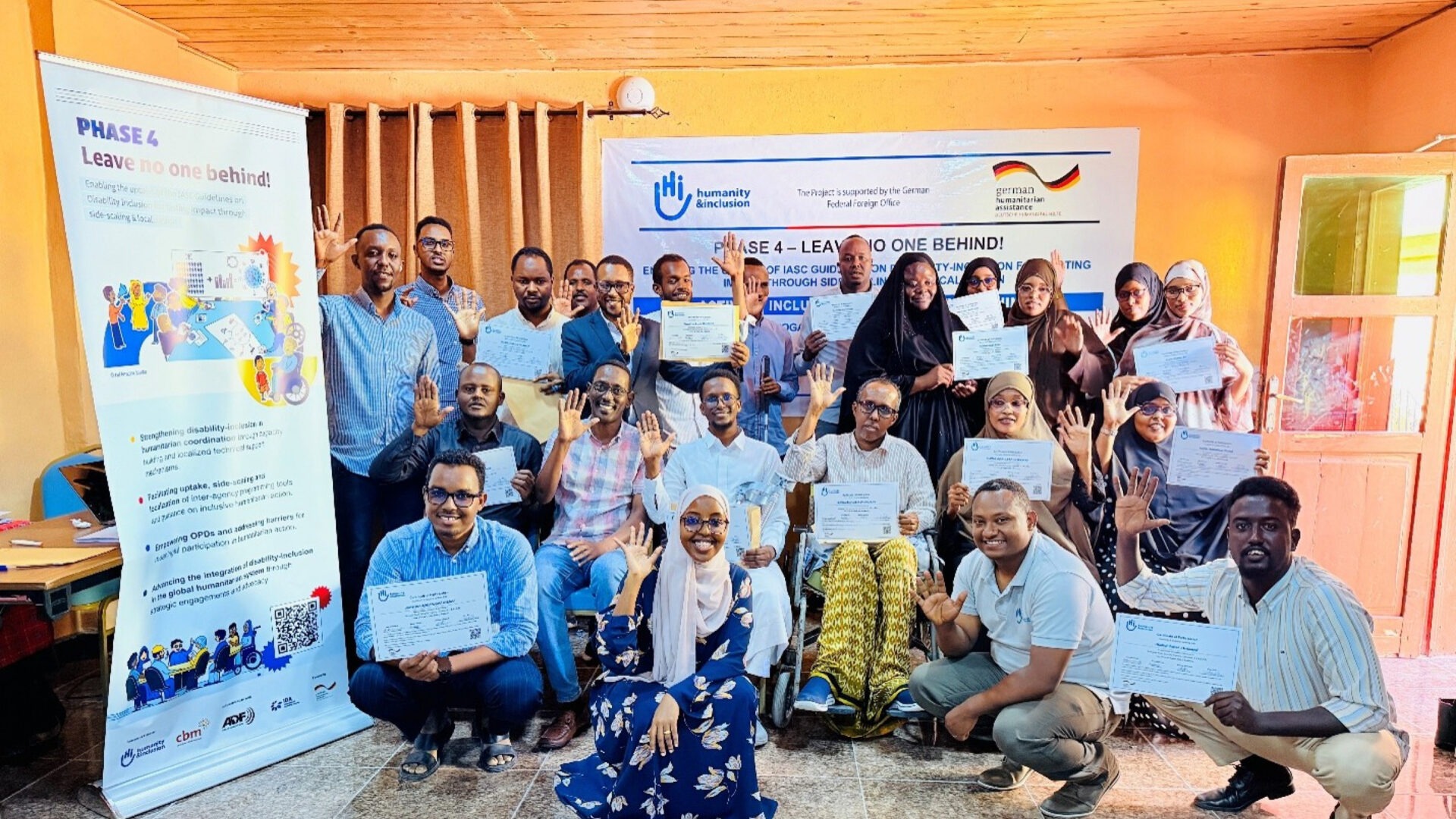
© Abdishakur Abdillahi- Senior MEAL Officer
How can food security programmes better include persons with disabilities? In August 2024, humanitarian actors, food security specialists and Organisations of Persons with Disabilities (OPDs) came together in Mogadishu to explore practical solutions. Through the newly launched Inclusive Food Security training package, participants strengthened their capacity to make food security and cash assistance programmes more accessible and inclusive.
Building Capacity for Disability-Inclusive Food Security in Somalia
From 17th–20th August, the HI Somalia/Somaliland team conducted a four-day Disability Inclusion in Food Security training for food security actors in Mogadishu, using the newly launched Disability Inclusion Food Security training package. This was the first training delivered using the package in Somalia and brought together 22 participants, including humanitarian practitioners, food security specialists, and cluster representatives from international and local organizations, women led organizations, and Organizations of Persons with Disabilities (OPDs). The training aimed to strengthen participants’ technical capacity to integrate disability inclusion across food security and Cash and Voucher Assistance (CVA) programming in Somalia.
Exploring the Inclusive Food Security Training Package
The Inclusive Food Security training was designed to enable food security actors to gain a deeper understanding of disability inclusion and its practical application across food security interventions. This training provided an important opportunity for food security actors in Somalia to explore and familiarize themselves with the newly launched Inclusive Food Security (iFS) training package and consider how its guidance can be applied within their programming.
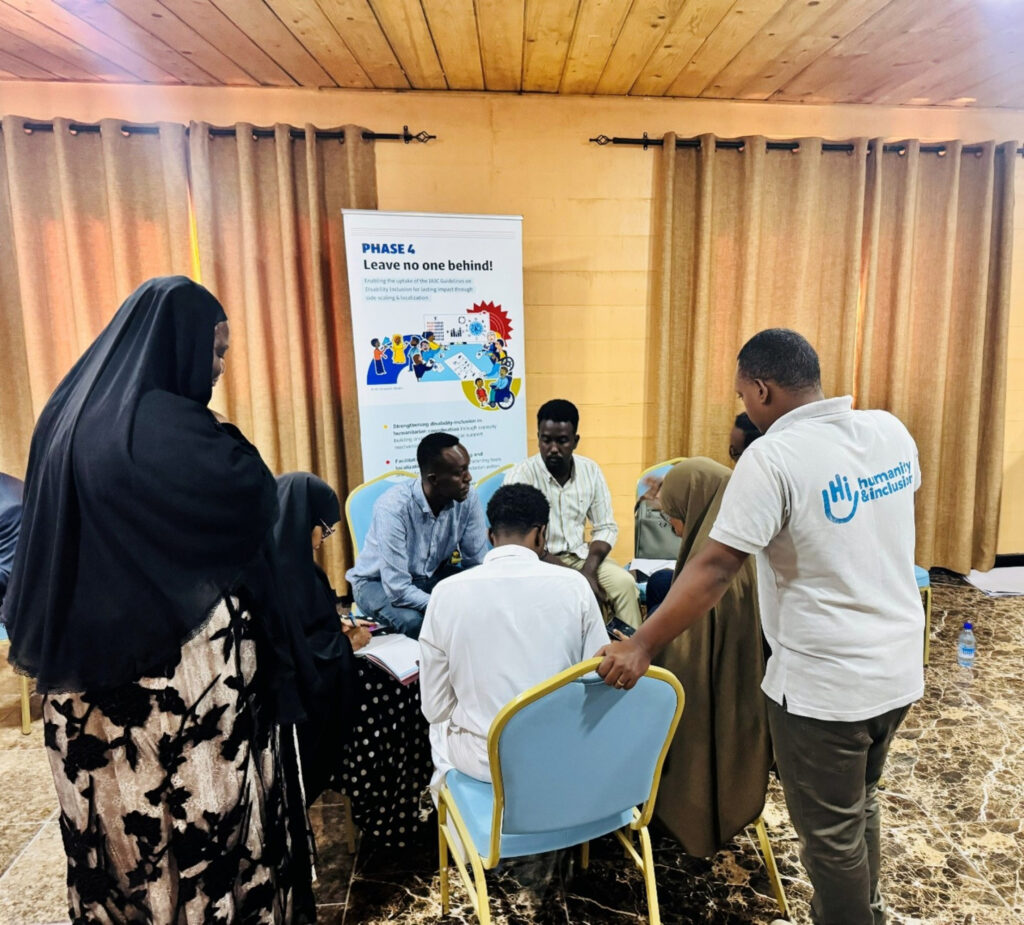
Over the four days, participants explored key sessions including disability and intersectionality, accessibility, universal design, reasonable accommodation, budgeting for inclusion, and disability inclusive Cash and Voucher Assistance (CVA). The sessions combined technical knowledge with practical approaches to support participants in identifying and addressing barriers faced by persons with disabilities throughout the food security programming cycle.
The workshop’s strength layed in its practical orientation where participants moved beyond theoretical discussions to examine real-world scenarios and operational challenges that arise in food security programming. Sessions focused on how to assess accessibility, identify disability-related barriers and appreciate disability-associated extra costs in relation to cash assistance programmes. This practical approach helped participants understand that disability inclusion is not an additional activity implemented at the end of a project but must be embedded from the earliest stages of assessment and planning through implementation, monitoring, and evaluation.
Nothing About Us Without Us
A defining feature of the training was the direct participation of OPDs and co-facilitators with disabilities. Their involvement ensured that discussions were also informed by lived experience. The principle of “Nothing About Us Without Us” was evident throughout the workshop. Participants heard first-hand accounts of the challenges persons with disabilities encounter when accessing humanitarian assistance, including inaccessible distribution sites, information that is not available in accessible formats, transportation barriers, stigma, and exclusion from community decision-making processes. These perspectives reinforced a critical lesson for humanitarian actors: persons with disabilities should not be viewed solely as beneficiaries of assistance but as leaders, experts, partners, facilitators and agents of change whose participation strengthens programme quality and accountability.
Key Takeaways and Reflections
“Meaningful engagement between food security actors and OPDs is essential to ensuring that programmes are responsive to the needs and priorities of persons with disabilities. Strong coordination and partnership create opportunities for more inclusive and effective humanitarian action.”
Abdullahi, Executive Director of the Somali Disability Network.
“It was an inspiring and eye-opening experience to receive this training from a person with visual impairment. It demonstrated that persons with disabilities have the capacity and willingness to actively contribute to ongoing engagement. The training provided an opportunity to learn through both practical experience and shared learning. Moving forward, we must strengthen meaningful inclusion of persons with disabilities in our food security interventions.”
Ahmed Hashi from Save the Children
Text by: Mohamed Khalif- IHA Intern